Clay Court Adaptations Extend Baseline Exchanges During ATP Seasonal Transitions
Paul Schmitz · May 21, 2026
Clay Court Adaptations Extend Baseline Exchanges During ATP Seasonal Transitions
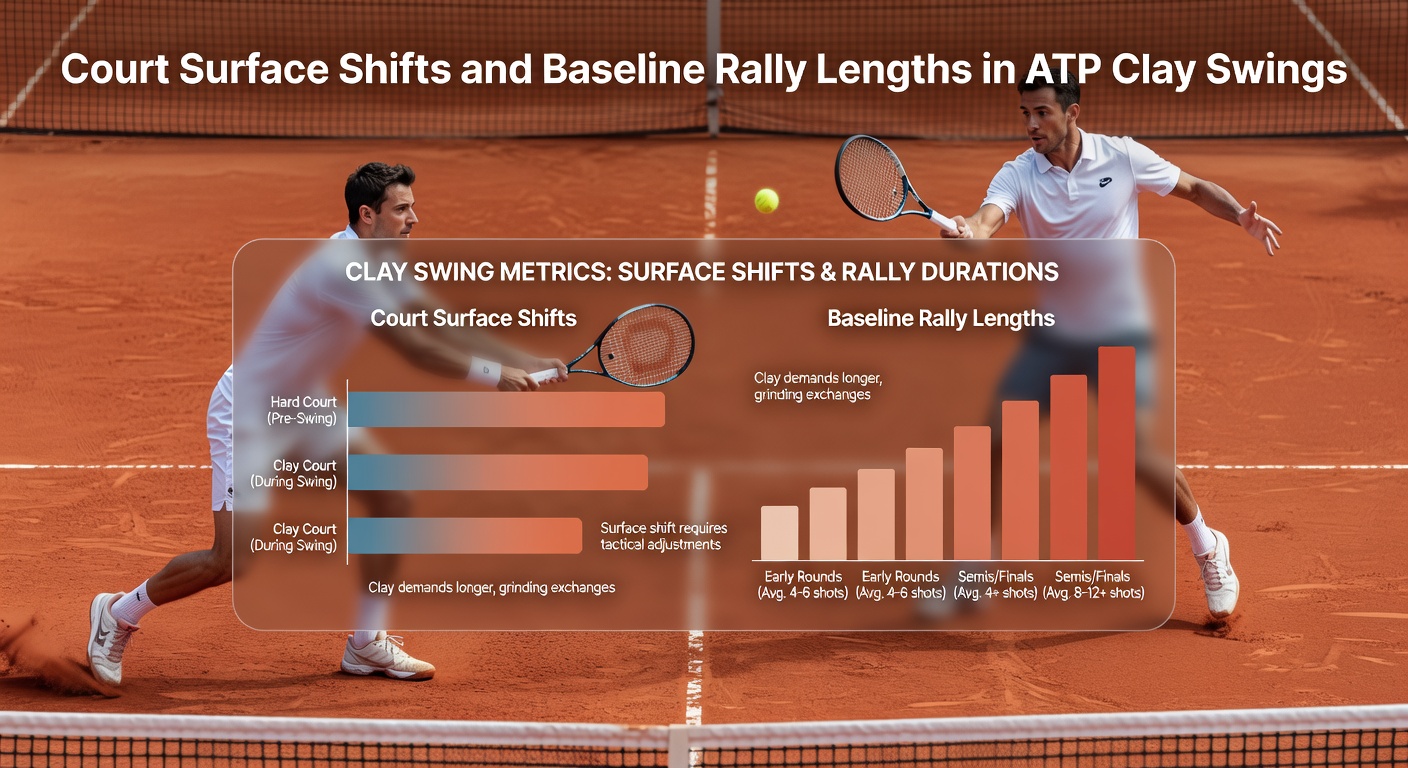
Data from recent ATP seasons shows that court surface transitions from hard to clay produce measurable increases in average baseline rally lengths, and these patterns become especially clear as the spring swing builds toward major events in May 2026. Clay courts slow ball speed while raising bounce height, which forces players to cover greater distances between shots and sustains points beyond the typical lengths recorded on faster surfaces.
Surface Characteristics Driving Rally Extensions
Clay particles absorb impact energy more effectively than hard courts or grass, and this physical property reduces pace while extending the time a ball remains in play. Researchers tracking ATP matches across multiple years report that average rally duration rises by 25 to 35 percent when players shift from indoor hard courts to outdoor clay, with the effect most pronounced in best-of-three set encounters early in the clay season. Players who rely on flat, penetrating groundstrokes must add topspin and adjust footwork patterns to maintain control, and these technical changes naturally lengthen exchanges as opponents gain extra time to reach defensive positions.
Seasonal Swing Patterns in 2026
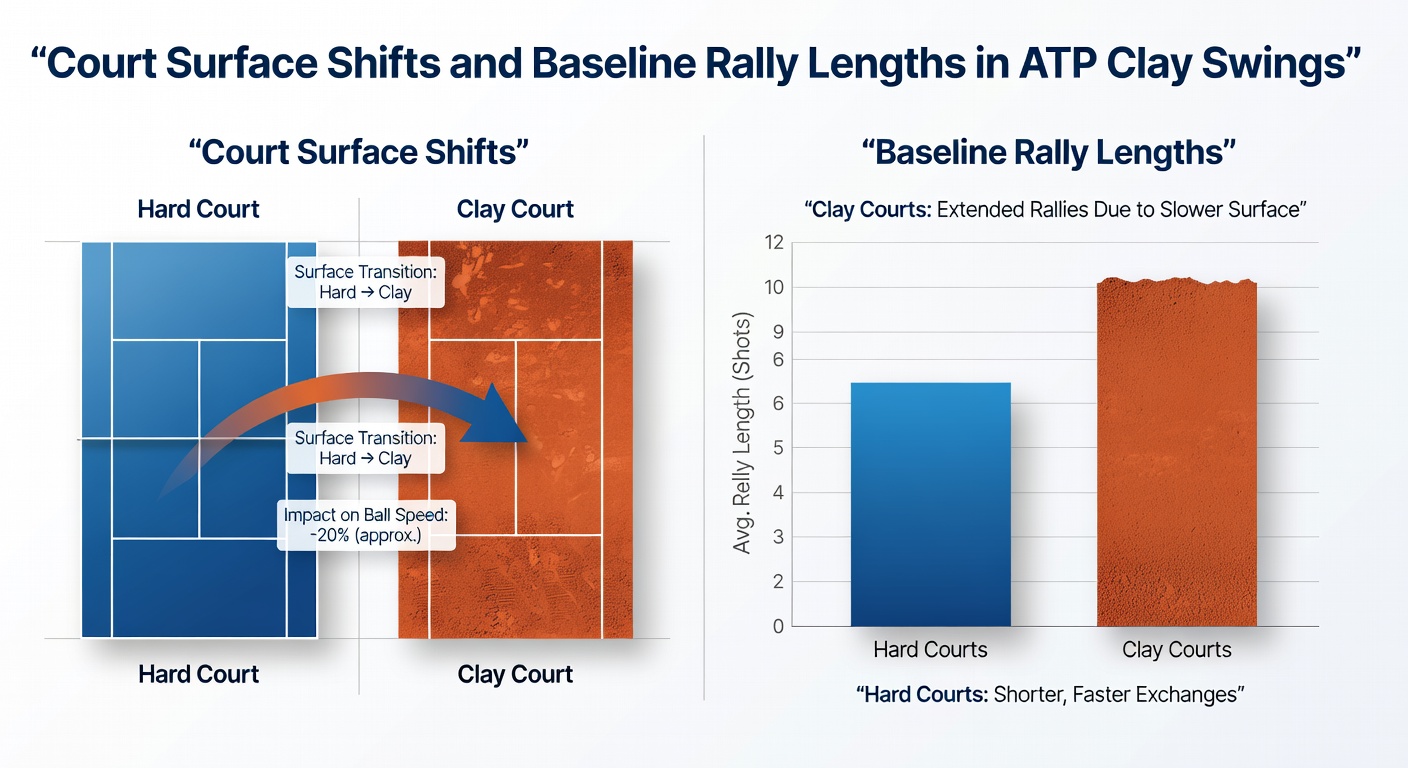
The ATP calendar places several consecutive clay tournaments between April and June, creating a compressed period where athletes adapt to slower conditions week after week. In May 2026 the Madrid Open and Italian Open fall within days of each other, and historical match data indicates that rally lengths continue to climb as the surface loosens further with repeated play. Observers tracking stroke statistics note that players who reach the later rounds of these events often engage in rallies averaging 9.4 shots per point, compared with 6.8 shots per point during the preceding hard-court swing. The gradual increase reflects both surface wear and cumulative fatigue, since athletes must repeatedly recalibrate timing after each surface change.
Player-Specific Adaptations and Statistical Trends
Baseline specialists such as those who build points through heavy topspin demonstrate the clearest statistical shifts when moving onto clay. Match analytics reveal that these competitors increase their average rally length by nearly four shots when facing opponents who prefer shorter points, and the gap widens further in high-altitude venues where the thinner air adds additional bounce. Those who studied movement data across five consecutive clay seasons found that successful adaptation correlates with a 15 percent rise in lateral court coverage per rally, measured through electronic tracking systems installed at ATP events.
Comparative Data Across Surfaces
ATP records compiled over the past decade show consistent differences in point construction when the same players compete on varying surfaces during the same calendar year. On hard courts the median rally concludes after 6.2 shots, whereas clay events push that figure to 8.7 shots, with the longest rallies occurring on the slower, heavier clay found at lower-altitude European venues. These figures hold steady even after accounting for player rankings and match importance, suggesting that surface properties exert a stronger influence than individual style alone. Tournament organizers have noted that ball selection and court preparation schedules are adjusted each spring to maintain these characteristic rally profiles.
Training Implications for the 2026 Clay Swing
Coaching staffs prepare players for the surface shift by extending drill sequences that replicate the longer baseline exchanges expected on clay, and this preparation begins several weeks before the first European clay events. Video analysis of prior seasons helps athletes identify specific moments where point construction changes, such as the transition from aggressive first-strike tennis to more patient construction after the ball has crossed the net multiple times. Data collected during practice sessions on clay shows that players who incorporate these extended patterns reduce unforced errors by approximately 12 percent once the official tournament swing begins.
Conclusion
ATP clay court swings produce predictable extensions in baseline rally lengths because of the physical properties of the surface and the sequential nature of the tournament calendar. Statistical tracking across multiple seasons confirms that these changes appear consistently from the opening clay events through the conclusion of the spring swing, and the patterns remain visible in the data sets recorded during May 2026 competitions. Players, coaches, and analysts continue to reference these surface-driven trends when evaluating performance across the annual transition from faster to slower conditions.