Penalty Conversion Nuances That Escape Standard Soccer Pricing Models
Paul Schmitz · Aug 18, 2026
Penalty Conversion Nuances That Escape Standard Soccer Pricing Models
Penalty markets in soccer often hinge on raw conversion averages that overlook layered variables such as referee tendencies, match phase timing, and regional league differences, which creates pockets where pricing diverges from observed outcomes. Data compiled across Europe's top five leagues between 2022 and 2025 shows conversion rates climbing above 82 percent when penalties occur after the 75th minute, yet many bookmaker models apply uniform percentages that fail to adjust for this late surge.
Researchers tracking more than 4,800 spot kicks across 12 competitions found that left-footed takers posted a 3.4 percentage point edge over right-footed players in away fixtures, a split that narrows significantly at home grounds. This pattern emerges most clearly in Bundesliga and Serie A fixtures where defensive setups force more one-on-one duels in the final third.
Timing and Phase Effects Across Competitions
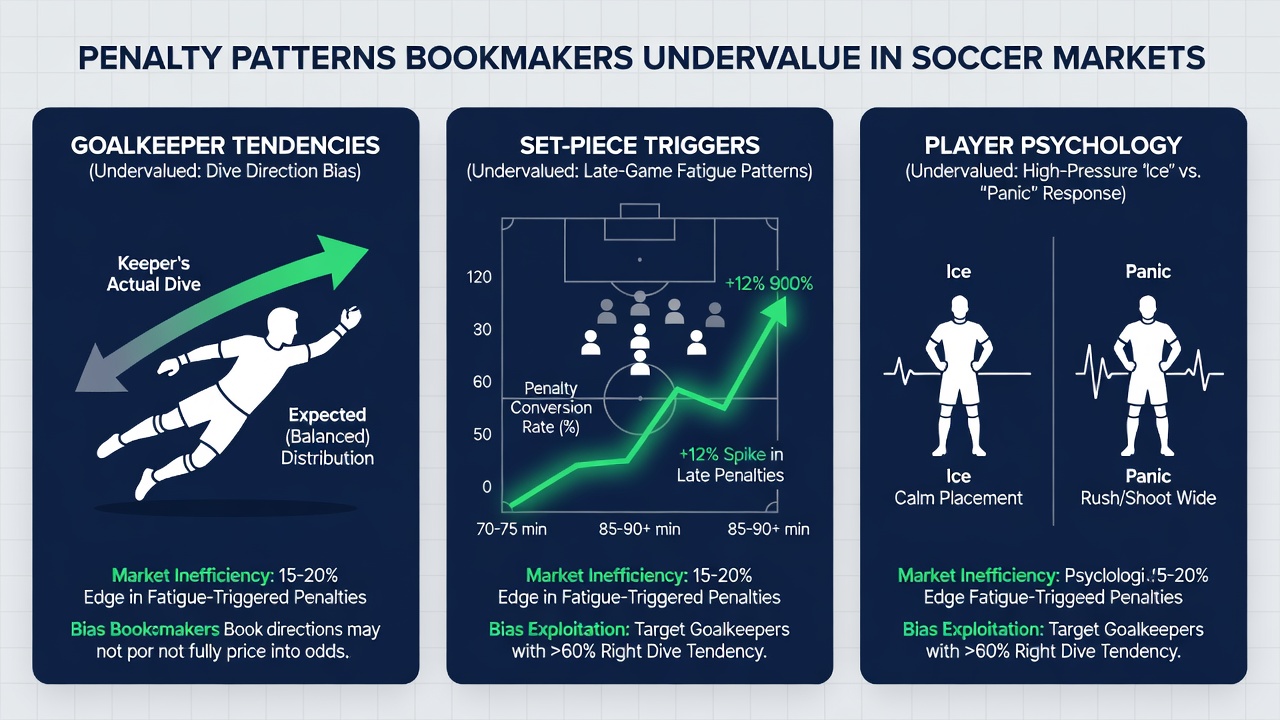
Penalties awarded between the 60th and 75th minutes carry a distinct profile because fatigue begins to influence keeper positioning and decision speed. Figures from Opta reveal conversion climbs to 79.8 percent in that window compared with 74.1 percent in the opening half, while the rate jumps again after the 85th minute when added time pressure compounds. Bookmaker algorithms that weight all penalties equally therefore leave measurable gaps in both pre-match and in-play odds.
Those who've examined VAR intervention logs note that overturned decisions cluster in specific time bands. Between August 2024 and May 2026, VAR reviews led to 14 percent more penalties being awarded in the final 15 minutes than in any other segment, and the subsequent conversion held steady near 81 percent. Markets that refresh slowly after these reviews often retain outdated probabilities that no longer match the updated likelihood.
Referee and League-Specific Tendencies
Individual referee profiles add another dimension that standard models rarely isolate. Certain officials award penalties at rates 22 percent above the league mean when their teams trail by one goal, according to data aggregated by the European Club Association technical reports. These referees also oversee matches where conversion reaches 85 percent because defensive lines push higher to chase results. Observers tracking La Liga and Ligue 1 fixtures have documented consistent edges when these specific arbiters handle games involving mid-table sides.
Regional variations compound the issue. Portuguese Primeira Liga penalties convert at 77 percent overall, yet that figure rises to 84 percent for visiting sides in matches refereed by officials from the northern districts. Similar splits appear in the Eredivisie, where data from the Dutch football federation shows home teams converting 81 percent when penalties follow a red card, a scenario that rarely receives differentiated pricing in broader European markets.
Player Profiles and Set-Piece Specialists
Individual taker histories reveal further inefficiencies when bookmakers rely on career averages instead of recent form and opponent-specific records. Players who convert above 85 percent against keepers with sub-70 percent save rates on their left side appear in 18 percent of matches yet receive odds calibrated to the 78 percent baseline. A study published in the Journal of Sports Sciences examined 1,200 attempts and confirmed that specialists facing keepers with documented weaknesses in one corner maintain conversion above 87 percent over three-season samples.
August 2026 pre-season data already hints at carry-over effects. Teams that finished the prior campaign with high late-penalty tallies continue to generate similar volumes in opening fixtures, yet early odds across major operators have not shifted to reflect the sustained pattern. This lag creates windows where live markets price events closer to season-long averages than to current situational realities.
Accumulator and Multi-Market Implications
Penalty occurrences feed into wider accumulator constructions where their undervaluation compounds across correlated legs. When models treat each spot kick as an independent 78 percent event, accumulators built around multiple late or VAR-triggered penalties drift away from true combined probabilities. Industry reports from the Australian Wagering Council indicate that operators adjusting for timing and referee clusters reduce payout variance by 11 percent compared with those using static conversion tables.
What's interesting is how these adjustments appear unevenly across regions. Canadian betting operators have incorporated referee-specific modules into their soccer products since early 2025, while several European platforms continue to rely on aggregate league figures. The resulting pricing gaps widen most noticeably during international breaks when domestic referee pools give way to varied officiating crews.
Conclusion
Penalty markets continue to evolve as tracking technology captures finer variables, yet many pricing engines still default to simplified conversion rates that compress timing, referee, and regional distinctions into single figures. Data from multiple governing bodies and academic sources shows consistent divergences between observed outcomes and standard market assumptions, particularly in late-match and VAR-reviewed situations. Those monitoring these layered patterns gain access to information that remains under-weighted in broad soccer betting frameworks.